ERP systems can hold some of a company's most important operational information.
Customer records, products, inventory, warehouse activity, purchasing, tasks and internal business data may all be connected in the same platform.
It is therefore reasonable to ask:
Is it safe to manage this information in the cloud?
The short answer is: it can be very safe.
But the cloud itself is not a security guarantee.
What matters is how the platform protects data, manages access, separates customers, monitors events and prepares for recovery.
Security is not a single feature
There is no single “security” switch.
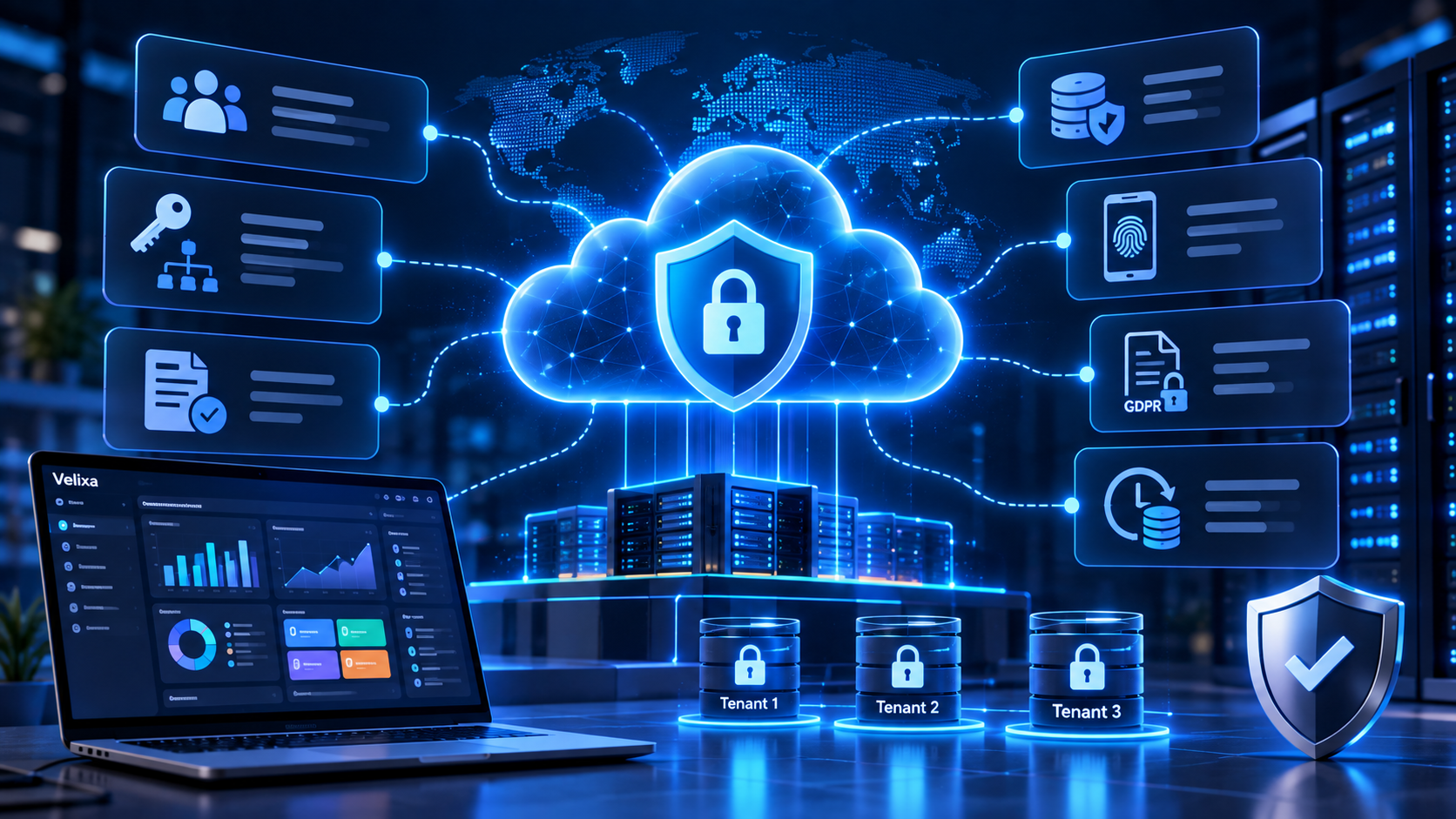
A secure business platform relies on several layers working together.
These may include:
- authentication,
- multi-factor authentication,
- access permissions,
- tenant isolation,
- audit logging,
- monitoring,
- backups,
- encrypted communication,
- updates,
- data protection processes.
The more important the data, the more important this layered approach becomes.
Why does MFA matter?
Passwords can be stolen, reused or captured through phishing.
Multi-factor authentication adds another verification step.
A compromised password alone may therefore no longer be sufficient to access the account.
For ERP systems, this matters because a single account may have access to significant amounts of business information.
Access control matters just as much
Not every employee should automatically see or modify every piece of information.
Warehouse staff, salespeople, managers and administrators may all require different levels of access.
A well-designed business system can use roles and permissions to apply the principle of least privilege.
Users receive the access required for their responsibilities without automatically receiving more.
What is tenant isolation?
In a multi-tenant SaaS environment, several companies may use the same service.
Their information must remain securely separated.
This is known as tenant isolation.
It can be implemented through different technical approaches, including logical separation, separate schemas, separate databases or combinations of these methods.
The important outcome is clear separation between customer environments.
Why are audit logs important?
In business software, the current state of a record is not always enough.
Organisations may also need to know:
- who created it,
- who changed it,
- when the change happened,
- which action was performed,
- which account was involved.
Audit logs can support troubleshooting, internal controls and security investigations.
What happens if data is lost?
Security is not only about preventing unauthorised access.
It is also about recovering from failure, human error or another incident.
A proper backup strategy should consider:
- backup frequency,
- retention,
- available restore points,
- recovery testing,
- separation from the primary environment.
A backup has real value only when it can actually be restored when needed.
Encrypted communication
Connections between users and the ERP platform should use encrypted channels.
HTTPS is now a basic requirement.
It helps protect information while it travels between the user's device and the service.
But security must also extend to application components, APIs, databases and supporting infrastructure.
Logging and security monitoring
Not every suspicious event can be prevented in advance.
This makes detection important.
Monitoring may help identify:
- unusual login activity,
- repeated failed sign-ins,
- suspicious operations,
- abnormal API usage,
- unexpected security events.
A system that records and reviews these events can respond more effectively than one that remains blind to them.
What about GDPR?
For companies operating in the European Union, data protection is a major consideration.
GDPR is not purely an IT issue.
It affects the entire lifecycle of personal data.
Business systems can support compliance through areas such as:
- access control,
- logging,
- data export,
- deletion processes,
- structured data handling.
Technology alone does not make an organisation GDPR-compliant, but it can provide the tools needed to implement appropriate processes.
Cloud or on-premises: which is safer?
There is no universal answer.
A professionally managed on-premises environment can be highly secure.
A poorly configured cloud environment can be risky.
The opposite is also true.
Security depends more on factors such as:
- infrastructure quality,
- patch management,
- access control,
- backup strategy,
- monitoring,
- secure development,
- operational discipline.
One major advantage of SaaS is that these controls can be managed centrally and consistently.
How does Velixa approach security?
Security is intended to be a fundamental part of Velixa's architecture rather than an optional add-on.
The platform's approach includes areas such as:
- tenant separation,
- user and role-based permissions,
- two-factor authentication,
- audit logging,
- security event handling,
- monitoring,
- regular backups,
- data protection processes.
The objective is not simply to create a “Security” page.
Security should be reflected throughout the platform.
Users are part of security too
Technology cannot eliminate every risk.
User behaviour remains important.
Organisations should encourage:
- strong, unique passwords,
- MFA,
- individual user accounts,
- regular permission reviews,
- removal of unnecessary access,
- caution with suspicious links and files.
Security is a shared responsibility.
Conclusion
Cloud ERP can be highly secure when protection is designed as a complete system rather than a single feature.
Strong authentication, appropriate permissions, tenant isolation, auditability, monitoring, backups, encrypted communication and responsible data handling all play a role.
The most important question is not simply whether an ERP is “in the cloud”.
It is how the platform is designed and operated.
Critical business data deserves nothing less.
Security. Visibility. Control.