Customer relationships are among the most valuable assets of any business.
In the early stages of a company, it may be easy to remember when a customer was last contacted, who the key contact person is, what proposal was sent, or when somebody needs to follow up.
As the number of customers and employees grows, this becomes increasingly difficult.
Information can end up scattered across emails, notes, spreadsheets and separate applications.
This is where a CRM system can help.
What does CRM mean?
CRM stands for Customer Relationship Management.
CRM is not simply a piece of software.
It is an approach to managing information and processes related to customers, prospects and business partners in a consistent and structured way.
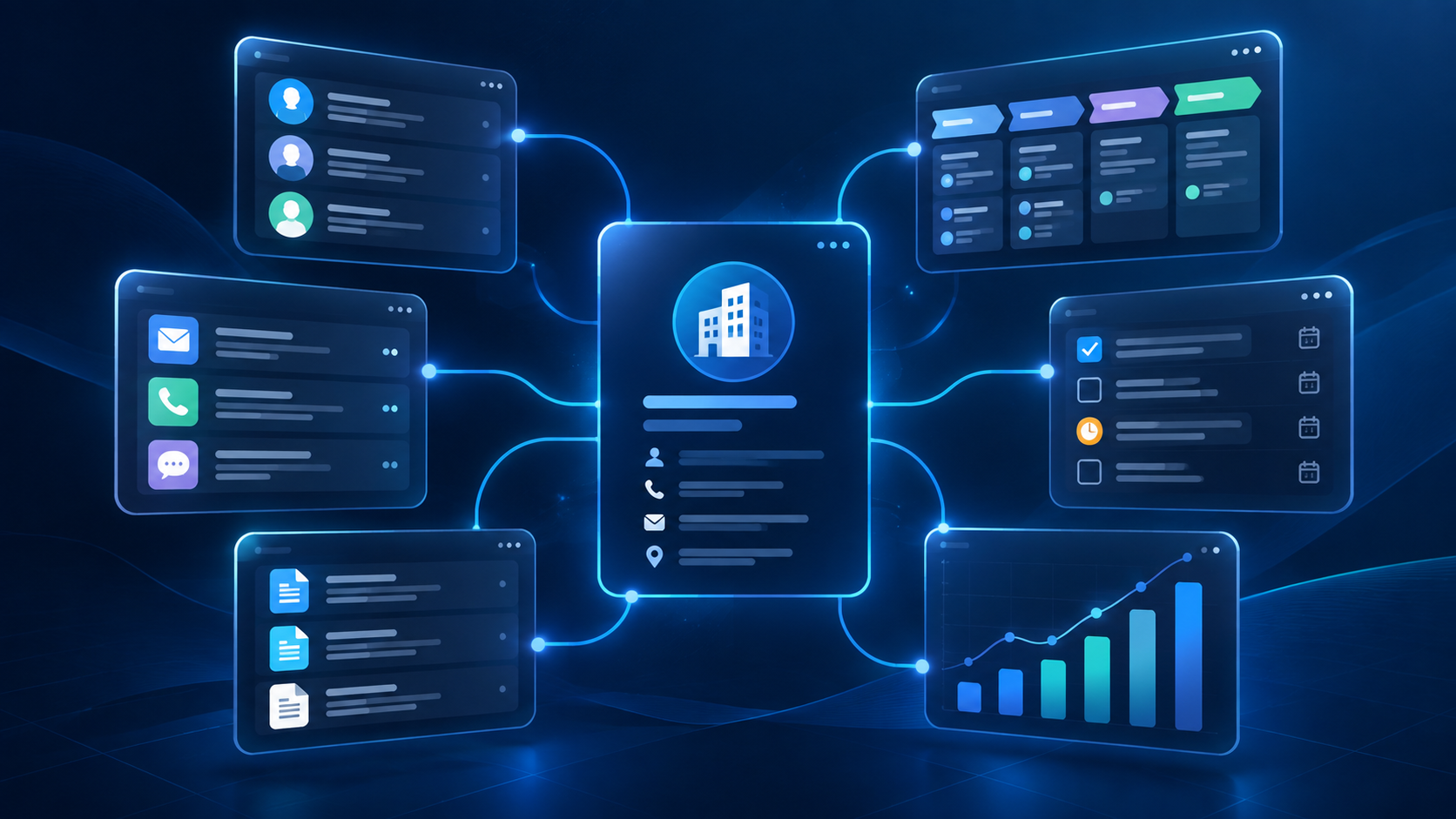
A CRM system can bring together information such as:
- customer and partner records,
- contacts,
- sales activities,
- tasks and deadlines,
- important communication history,
- related documents,
- stages of the sales process.
The objective is simple: when an employee needs information about a customer, they should not have to search through several unrelated systems.
Why is a customer list not enough?
A spreadsheet can easily store a company name, contact person, email address and telephone number.
For a while, that may be completely sufficient.
But a real customer relationship contains much more context.
For example:
- When was the customer last contacted?
- What was discussed?
- Which proposal was sent?
- Is there an open task?
- When should somebody follow up?
- Who owns the relationship?
- What previous business activities are related to this customer?
A CRM is therefore more than an address book.
Its purpose is to maintain the business context surrounding the relationship.
How does a CRM system work?
Consider a simple example.
A new prospect contacts the company.
A customer or partner record is created in the CRM. One or more contact people can be associated with that organisation.
A sales employee records the interaction and creates a follow-up task. Future activities can then be linked to the same customer.
Weeks or months later, authorised colleagues can still understand:
- who worked with the customer,
- which activities have already taken place,
- which tasks remain open,
- where the relationship currently stands.
This becomes particularly useful when more than one employee is involved.
What problems can CRM help solve?
Lost customer information
When important information exists only in one employee's inbox or private notes, the company becomes heavily dependent on that individual.
CRM can make relevant customer information accessible within a shared business system.
Missed follow-ups
“Call them again next Tuesday.”
A simple promise can easily become a forgotten task.
Connecting tasks and deadlines directly to the customer can make follow-up more reliable.
Duplicate communication
It can be uncomfortable when two colleagues contact the same customer independently about the same issue.
Shared visibility helps teams coordinate their activities.
Difficult handovers
Holidays, illness or staff changes can make customer relationships difficult to hand over if the history exists only in one person's memory.
A properly maintained CRM can help another authorised employee understand the relationship more quickly.
What can a CRM system be used for?
Customer and partner management
CRM provides a central location for customer and business partner information.
A company can have multiple contacts with different responsibilities and contact details.
Tasks and follow-up
Many customer-related activities are time-sensitive.
Examples include:
- phone calls,
- sending a proposal,
- meetings,
- requesting documents,
- scheduling the next conversation.
Connecting these tasks directly to the customer creates a clearer picture of what needs to happen next.
Sales processes
CRM can also help show where a prospect or opportunity currently sits within the sales process.
The exact workflow varies between systems, but the objective is the same: make the sales process visible and manageable.
Interaction history
Knowing when and why previous contact took place can be valuable.
Not every message needs to be stored in CRM, but recording important business events can preserve useful context.
When should a business consider CRM?
There is no specific number of customers or employees at which CRM becomes mandatory.
Typical signs include:
- customer information is stored in multiple places,
- follow-ups are regularly missed,
- several employees communicate with the same customers,
- previous interactions are difficult to reconstruct,
- responsibility for a customer is unclear,
- sales activity is becoming difficult to manage with spreadsheets.
As with ERP, process complexity is often more important than company size.
What is the difference between CRM and ERP?
CRM focuses primarily on customer relationships and sales-related processes.
ERP may cover a wider range of business operations.
This can include:
- products,
- inventory,
- warehouse operations,
- purchasing,
- deliveries,
- other operational processes.
However, CRM and ERP do not necessarily need to operate separately.
Within an integrated business platform, the two can work together.
The customer managed by the sales team is the same customer who may later place orders and become connected to products, deliveries and other business events.
For a broader introduction to ERP, read What Is an ERP System and When Does a Business Need One?.
Why can integrated CRM be valuable?
A standalone CRM can be an excellent solution.
Integration becomes particularly valuable when customer relationships connect directly to other business processes.
Sales employees may benefit from accessing relevant customer and operational information within the same environment.
This can reduce manual copying between applications and limit the creation of information silos.
What role can AI play in CRM?
Customer relationship management often generates large amounts of textual and event-based information.
This makes CRM an interesting area for AI assistance.
AI may help with:
- summarising longer customer histories,
- highlighting important events,
- reviewing open tasks,
- finding relevant information faster,
- preparing possible next steps.
The objective is not for AI to replace the salesperson or account manager.
It is to help them access the information required for good decisions more efficiently.
How does Velixa approach CRM?
In Velixa, partner management is designed as more than an isolated contact database.
The goal is to create a connected business environment in which companies, contacts, tasks and related business processes can work together.
Customer relationships rarely end with storing an email address or telephone number.
Over time, they can become connected to sales, products, purchasing, warehouse operations and other business activities.
Velixa is designed to reduce the number of isolated information silos between these areas.
Conclusion
A CRM system is much more than a customer database.
Used effectively, CRM can help businesses:
- keep important customer information in one place,
- manage tasks and follow-ups,
- reduce lost information,
- coordinate customer communication,
- make sales processes more visible.
As a company grows, it becomes increasingly important that customer relationships do not exist only in people's memories, inboxes and isolated spreadsheets.
A good CRM does not replace strong customer relationships.
It helps businesses manage them more consistently.
Less searching. More visibility. Better decisions.