What Is an ERP System and When Does a Business Need One?
In the early stages of a business, a few simple tools are often enough. Customer information may live in a spreadsheet, inventory in another file, tasks arrive by email, and documents are stored in separate folders.
For a while, this can work perfectly well.
As the business grows, however, the number of customers, products, orders, documents, tasks and business events increases. Information becomes scattered, the same data has to be updated in several places, and answering simple questions becomes increasingly difficult.
Questions such as:
What is currently in stock? What happened during our latest interaction with a customer? Which tasks are overdue? Which purchasing activities are in progress? What stage has a particular business process reached? Which version of the data is actually current?
This is where an ERP system can become valuable.
What does ERP mean?
ERP stands for Enterprise Resource Planning.
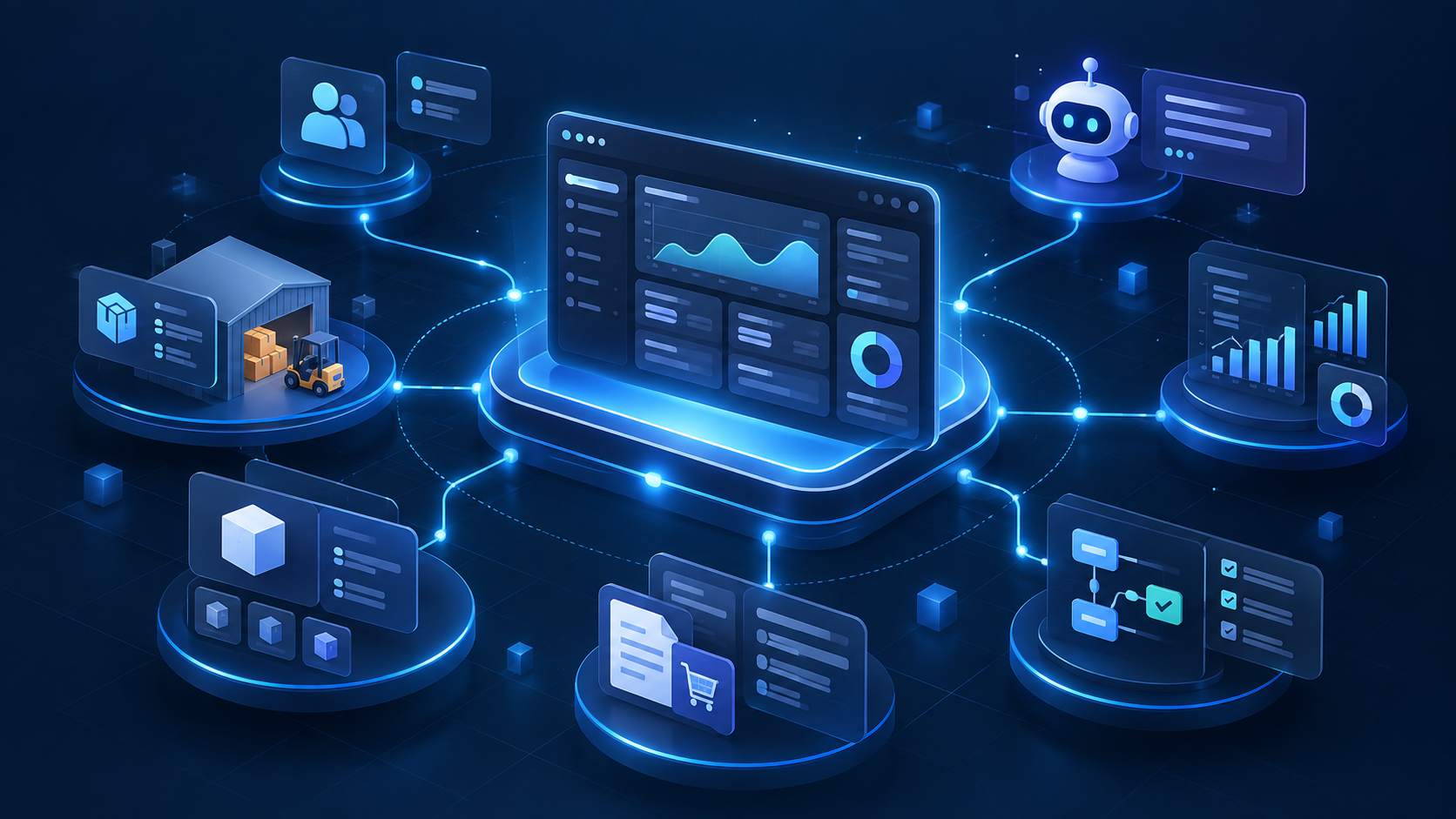
An ERP system is designed to connect different areas of a business within one shared environment instead of allowing each department or process to operate through isolated applications and files.
A modern ERP platform can connect areas such as:
customer and partner management, sales, products, inventory, warehouse operations, purchasing, tasks, documents, and management information.
The key concept is integration.
The value of an ERP system does not simply come from having many features. It comes from those features working with the same connected business data.
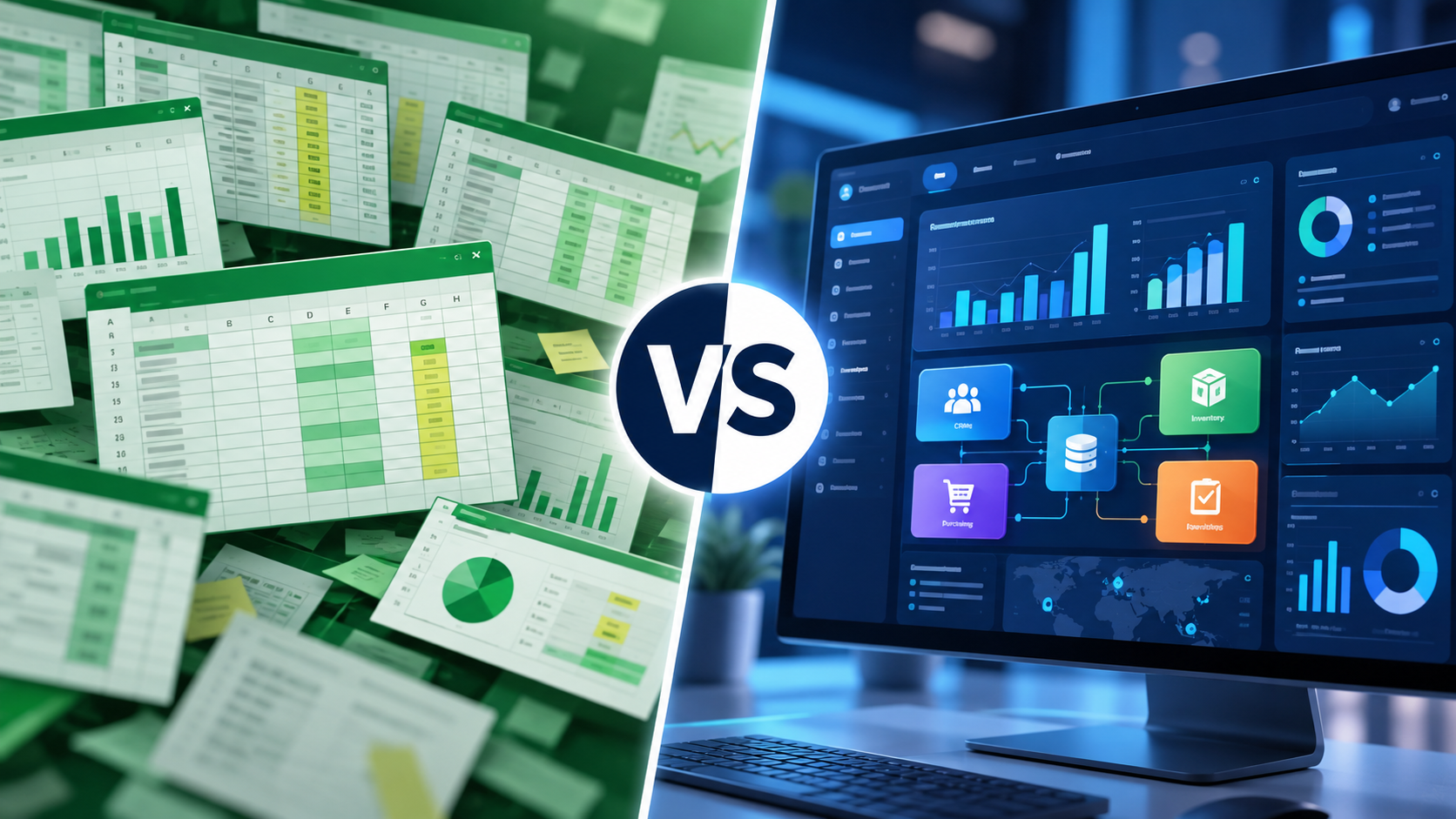
Why can spreadsheets and disconnected applications become a problem?
Spreadsheets are extremely useful business tools.
The problem begins when an organisation gradually relies on a growing collection of spreadsheets and separate applications to run its core processes.
Sales may maintain customer information in one file. The warehouse team may track inventory somewhere else. Purchasing may use another list, while managers manually combine several sources to understand what is happening.
This can create situations where:
the same information exists in multiple places, nobody is certain which version is current, the same change has to be entered several times, important details remain buried in emails or messages, reporting requires significant manual work.
One of the main purposes of ERP is to reduce this fragmentation.
How does an ERP system work?
In an integrated ERP environment, business entities and processes are connected.
Consider a simple example.
A company creates a new customer record. That customer can later be connected to contacts, tasks, sales activities or documents.
If the customer places an order, products become part of the process. Product availability can be linked to inventory and warehouse operations. If stock is insufficient, that information may become relevant to purchasing as well.
These business areas therefore do not have to operate independently.
This is one of the fundamental differences between an integrated business platform and a collection of unrelated software tools.
What are the potential benefits of ERP?
- Centralised business information
Employees can work with relevant information from a shared system rather than maintaining multiple independent copies of the same data.
This can reduce duplicate data entry and make information easier to find.
- Greater visibility
When processes are connected, it becomes easier to understand what is happening across different areas of the business.
Managers and authorised employees can access current information more efficiently.
- Less manual administration
Connected workflows can reduce the need to repeatedly transfer information from one application or spreadsheet to another.
This saves time and reduces opportunities for human error.
- More consistent processes
ERP can help organisations establish repeatable workflows instead of relying entirely on individual working methods.
This becomes increasingly important as the organisation grows and more people participate in the same processes.
- Better decision support
When business information is structured and accessible from one environment, creating reports, summaries and management views becomes easier.
The objective is not simply to store data, but to turn that data into useful business information.
What is the difference between ERP and CRM?
CRM stands for Customer Relationship Management.
A CRM system primarily focuses on managing relationships with customers and prospects.
This can include:
customer and partner records, contacts, sales opportunities, communication history, customer-related tasks.
ERP typically covers a broader range of operations.
In addition to customer-related processes, an ERP system may connect products, warehouses, inventory, purchasing and other operational areas.
In modern business platforms, the distinction between ERP and CRM is therefore becoming less rigid. The two areas can work closely together.
Is ERP only for large enterprises?
No.
ERP systems were historically associated mainly with large organisations. Traditional implementations could require substantial infrastructure, long implementation projects and significant investment.
Cloud-based SaaS systems have changed this considerably.
Small and medium-sized businesses can now use integrated business platforms without operating their own server infrastructure or maintaining a large internal IT team.
As a result, company size alone is not the best indicator of whether ERP is needed.
A more useful question is:
How complex are the company's business processes?
When should a business consider ERP?
Several signs may indicate that an organisation is beginning to outgrow its current tools.
The same information is maintained in several places
If customer, product or order information has to be entered into several applications or files, the process consumes time and introduces additional opportunities for mistakes.
The number of spreadsheets keeps growing
A few well-designed spreadsheets are not a problem.
But if employees no longer know which spreadsheet contains the latest information, a centralised system may be worth considering.
Getting answers takes too long
If answering a basic business question requires contacting several colleagues or combining several files, information is probably too fragmented.
Manual administration keeps increasing
Some administrative growth is natural as a company expands.
However, if every new customer or transaction creates almost the same increase in manual work, there may be opportunities for integration and automation.
The business is growing rapidly
A process that works for five people may become a bottleneck for twenty or fifty.
Business systems should therefore support not only today's organisation, but also its expected growth.
What should you look for when choosing an ERP system?
The ERP platform with the longest feature list is not automatically the best option.
Businesses should consider whether the system:
fits their actual workflows, is easy for employees to use, can support future growth, provides suitable permissions and access control, protects business data, supports relevant integrations, can be implemented efficiently, and remains practical for everyday work.
A successful ERP implementation depends on both technology and a clear understanding of the company's processes.
What role can AI play in ERP?
Artificial intelligence is creating new possibilities for business software, but AI does not replace structured data or well-designed processes.
Its greatest value can emerge when it helps users understand and work with information that already exists in the business system.
AI may help with tasks such as:
summarising larger amounts of information, highlighting relevant details, reviewing business activity, preparing possible next steps, simplifying interaction with complex systems.
The objective is not for AI to make business decisions instead of people.
It is to make useful information easier and faster to access.
How does Velixa approach ERP?
Velixa is being developed as a modern, modular business platform designed to connect important company processes instead of treating them as isolated areas.
Customer and partner management, products, inventory, warehouse operations, purchasing, tasks and other business functions can form part of the same connected environment.
Velixa focuses on usability, visibility, data security and intelligent assistance.
Its AI capabilities are designed not as a standalone novelty, but as a way to make business information easier to understand and use.
Conclusion
ERP is not simply about introducing another piece of software.
Its purpose is to replace fragmented information and disconnected processes with a more integrated way of running a business.
A well-chosen ERP system can help an organisation:
reduce information fragmentation, decrease manual administration, standardise processes, improve operational visibility, and create a stronger foundation for growth.
If a growing business increasingly depends on spreadsheets, disconnected applications and manual processes, it may be time to explore what an integrated ERP platform can provide.
Less searching. More visibility. Better decisions.