Business operations rarely become complicated overnight.
First there are a few customers.
Then more products.
Inventory appears, warehouse processes grow, purchasing becomes more structured, and the number of tasks, documents and employees increases.
Along the way, new tools are added.
A spreadsheet for customers.
Another for inventory.
A separate CRM.
A task manager.
Emails, documents, shared folders and information that sometimes only one employee knows how to find.
For a while, this works.
Eventually, however, more and more time is spent managing fragmented information rather than running the business itself.
Velixa started with this problem.
We do not want to build just another isolated business app
There are already many excellent business applications available.
For many companies, the problem is not necessarily the lack of software.
It is having to use too many disconnected tools at the same time.
Customer information may exist in one system.
Products in another.
Inventory somewhere else.
Tasks in a separate application.
Management reporting may then require manual consolidation across several systems.
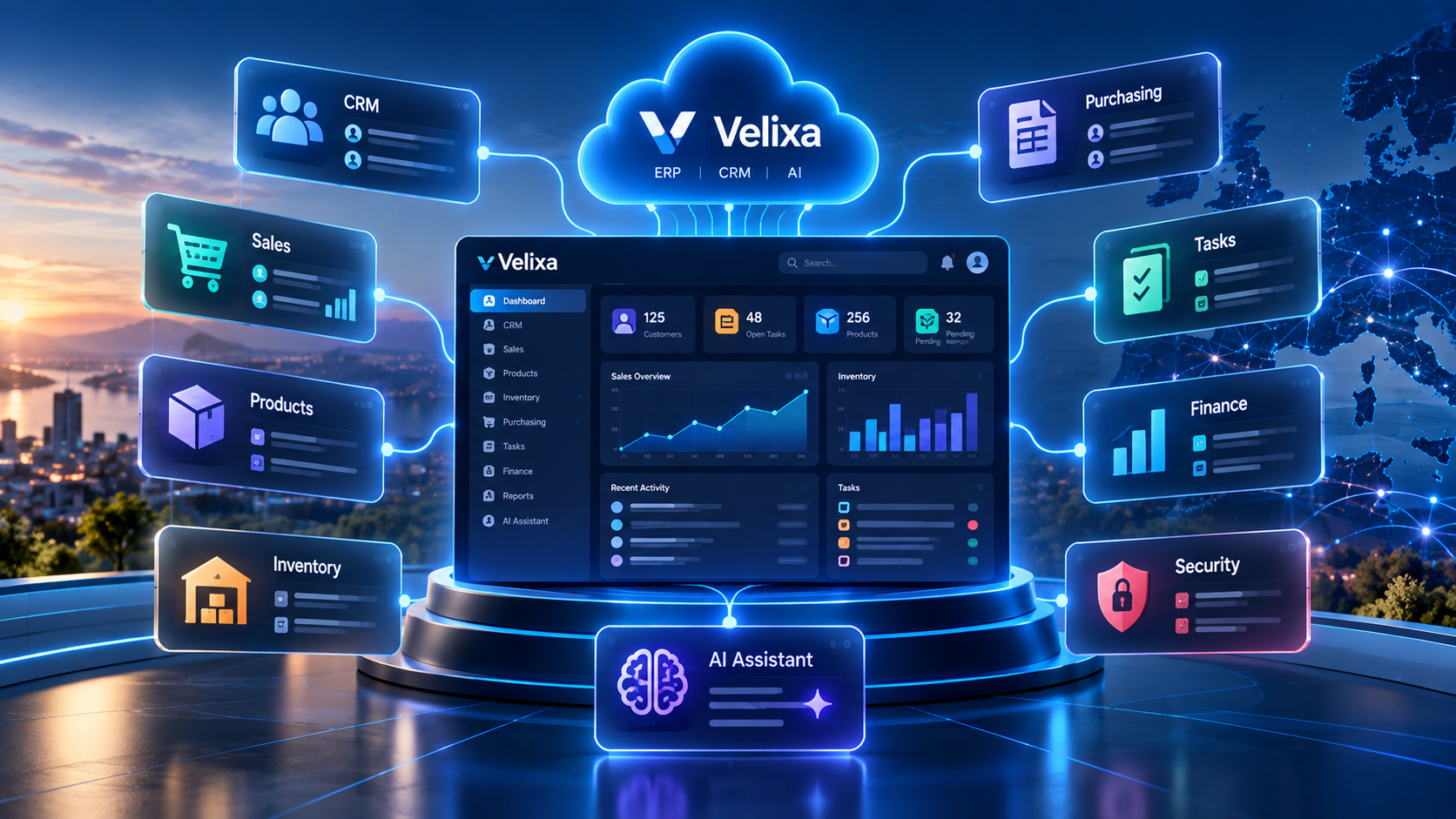
One of Velixa's core principles is therefore that important business areas should not exist as isolated information islands.
They should be able to work together as part of a shared platform.
ERP and CRM in one connected business environment
Traditional CRM focuses primarily on customers and sales.
ERP covers a broader range of operational processes.
In real businesses, however, the two are closely connected.
A customer may:
- interact with sales,
- receive a proposal,
- place an order,
- affect inventory,
- trigger warehouse activity,
- create internal tasks,
- generate further business events.
Velixa therefore does not treat CRM and ERP as completely separate worlds.
The goal is a connected business data model.
For a broader introduction, see What Is an ERP System and When Does a Business Need One?.
Modularity without unnecessary fragmentation
No two companies operate in exactly the same way.
A trading business may depend heavily on inventory and purchasing.
A service company may place greater emphasis on customer management and tasks.
A growing organisation may need additional business areas later that were unnecessary at the beginning.
Velixa is therefore being built as a modular platform.
The objective is not to expose users to dozens of disconnected mini applications.
It is to provide one coherent environment containing the capabilities each business needs.
Usability is not secondary
An ERP system can be functionally powerful and still be difficult to use.
If employees need extensive training for every basic activity, the software itself becomes an obstacle.
An important development goal for Velixa is therefore to place understandable interfaces around complex business processes.
This does not mean every process can be simple.
Warehouse management, purchasing and permissions can be inherently complex.
The interface should not make that complexity worse.
AI should do useful work
Artificial intelligence is an important part of Velixa's long-term direction.
But not because the words “AI-powered” look good on a product page.
AI creates value when it makes real work easier.
This may include:
- summarising business events,
- highlighting relevant information,
- finding data faster,
- preparing possible next steps,
- making complex information easier to understand.
Velixa's approach is not for AI to replace the user's judgement.
Its purpose is to provide better context for decisions.
Read more in AI in ERP: Real Business Value or Just Marketing?.
Automation should give time back
Businesses perform many repetitive, rule-based activities every day.
Creating tasks.
Sending reminders.
Updating statuses.
Moving information between processes.
Approvals.
Notifications.
Velixa's automation direction is focused on reducing unnecessary manual administration.
Not every process should be automated.
But when software can reliably handle a repetitive step, employees should not have to recreate it manually every time.
Security cannot be an afterthought
When software handles business data, security cannot be optional.
Important areas in Velixa's design include:
- user and permission management,
- two-factor authentication,
- auditability,
- security event handling,
- tenant separation,
- backups,
- data protection processes.
The goal is not to make security a separate feature.
Security should be reflected throughout the platform.
For more, read Cloud ERP Security: How Safe Is It?.
Designed with Europe in mind
Velixa's long-term direction is the European market.
That means more than simply translating the interface.
European businesses operate in an environment where factors such as the following matter greatly:
- data protection,
- GDPR,
- multiple languages,
- different national business requirements,
- local integrations,
- cross-border growth.
Velixa is therefore being developed with multilingual and multi-market operation in mind from the foundations.
We do not want to build everything at once
A modern business platform is an enormous system.
CRM, inventory, warehousing, purchasing, finance, HR, manufacturing, automation, mobile capabilities and AI cannot become one stable product overnight.
Velixa is therefore being developed gradually.
The first objective is to create a strong and usable core platform.
Additional capabilities and business areas can then be built on that foundation.
This may be less dramatic than promising dozens of finished features immediately.
But our goal is to create a stronger product over the long term.
Why Velixa?
The idea behind Velixa is ultimately simple:
less fragmentation, more connected information.
A company should not need to search five different locations to understand one business process.
Management information should not require lengthy manual consolidation.
Technology should not create more administration than it removes.
Velixa is intended to become a business platform that can grow alongside the organisations using it.
This is only the beginning
Velixa is under continuous development.
This blog will therefore not only cover ERP, CRM, artificial intelligence, automation and security.
We also want to share Velixa's own development.
New capabilities.
Development milestones.
Product decisions.
And eventually, how businesses use the platform in practice.
Building business software is a long journey.
We want to share that journey too.
Less searching. More visibility. Better decisions.
This is Velixa.